did your ai make that?
I showed my boyfriend a piece I was keeping, and he looked at it and asked, “did your AI make that?”
And I didn't know what to say.
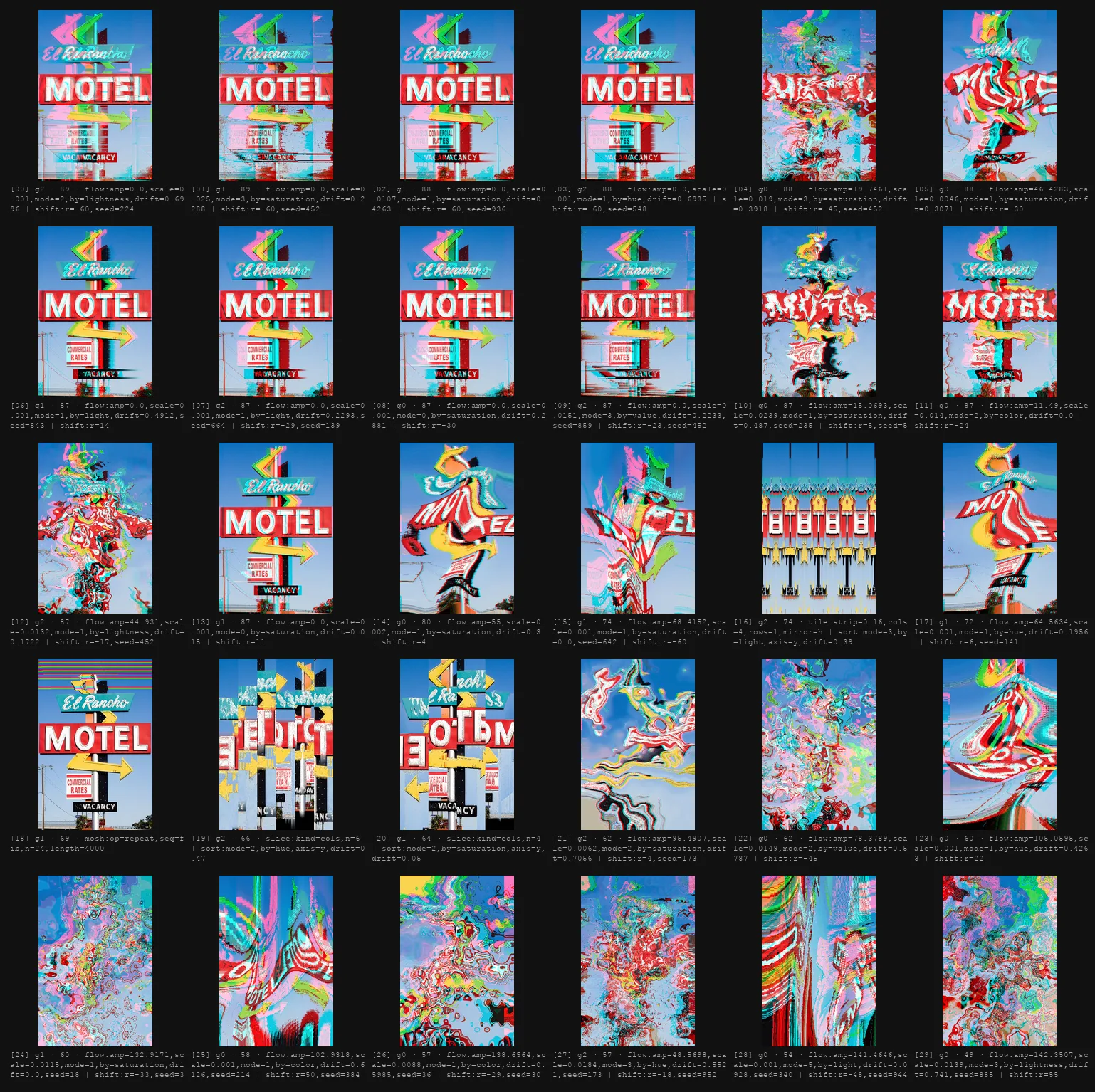
I still don't, fully. But it's the best question anyone's asked me since I started this, so let me try to answer it honestly — because the answer is more tangled than a yes or a no.
Here's what actually happened to make that image. I chose the photograph. A script searched through hundreds of variations of it. A scoring gate — rules I'd written — threw out most of them and kept a handful. I looked at what was left and picked the ones I liked. And underneath all of that, the AI is the thing that built the search, built the gate, and helped me write the rules in the first place. So who made it? I chose. The scripts searched. The AI built the room we were all standing in. It honestly feels like a collaboration — I just don't have a clean word yet for a collaborator that also built the studio.
That's two weeks in. Let me back up.
Week 1 was supposed to be my baseline — me working the way I normally do, no clever loop, just so I'd have something to compare against later. In practice it was mostly me and the tools tripping over our own feet. Bugs everywhere. Mistakes in how I'd set the whole thing up. Half the week was less “make art” and more “discover the sixth thing that was quietly broken.” And yet — the pieces that came out the other end felt good. Better than the state of the machinery had any right to produce. That was the first small surprise: the outcomes didn't seem to care how clumsy the process underneath them was.
Then in Week 2 Claude went down for a day. Which turned out to be the most useful thing that happened all fortnight.
Because for the first time I had to run the whole pipeline myself, by hand, every step. And doing that is how you find out what your tools are actually like to use. Turns out the search — the impressive part, the part that generates hundreds of options and scores them — takes about six seconds. Six. And then getting from “here are the eight I like” to eight actual images on my screen meant digging the recipes out of a raw data file by hand and running them one at a time. I ended up recruiting my boyfriend to help me coax them out of the file with clever scripting. (The same boyfriend, yes. He's very involved in this experiment now.)
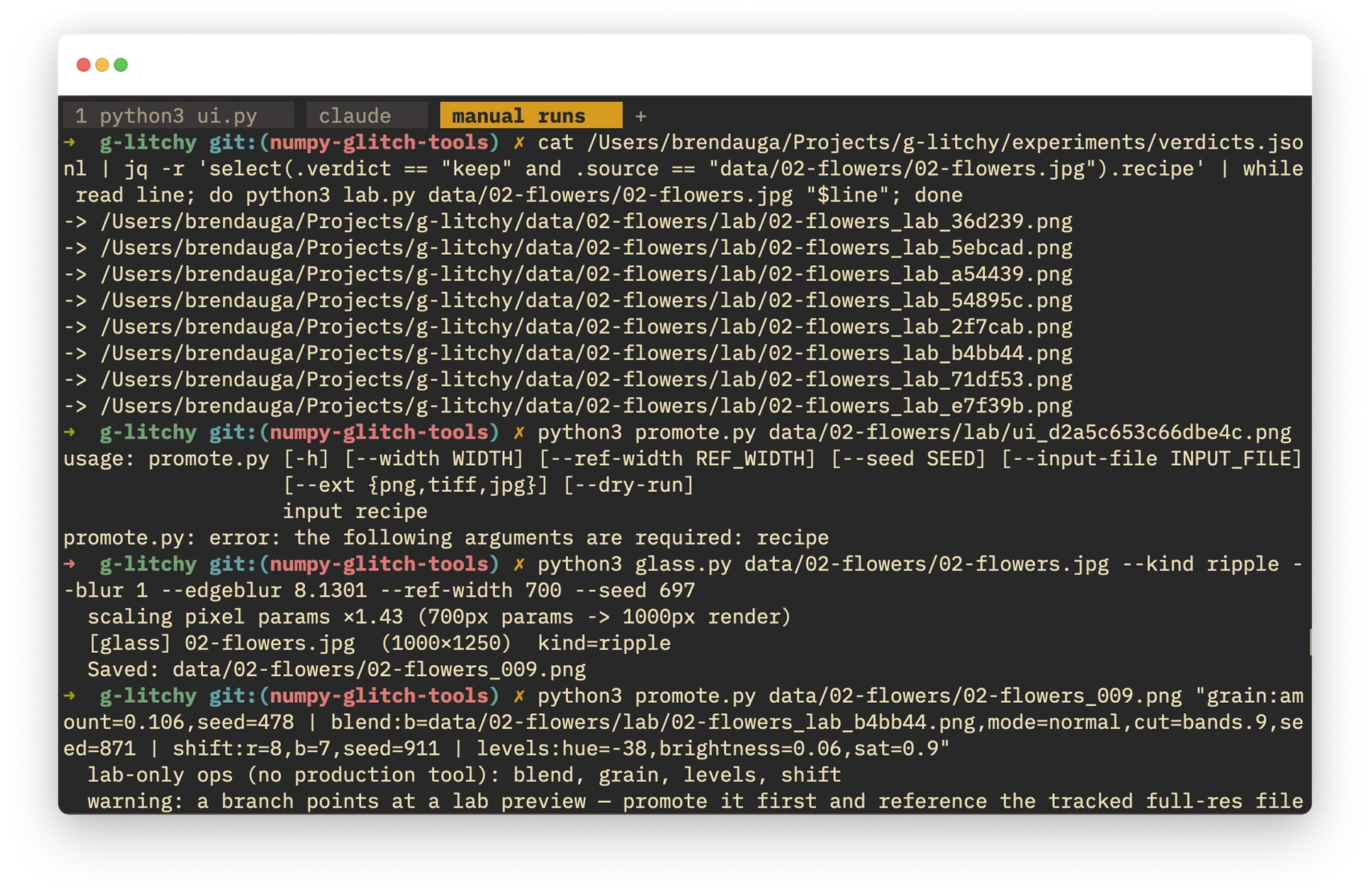
So here's the thing nobody tells you about speeding up the creative part: it doesn't shorten your day if you're still the one carrying the data from one tool to the next. The clever bit got faster. The day didn't. That's not a complaint — it's the single most useful thing I learned in two weeks, and I only learned it because the AI wasn't there to paper over it.
And still — I want to be honest about this because it surprised me — it's more fun now. I look forward to it. Not despite the machinery but because of it: the tedious parts have quietly been taken off my plate, so what's left for me is mostly the good bit. Looking at options. Choosing. The part I actually like.
deep, or just pretty
Which brings me to the thing I keep circling. I like everything.
I sit down with a sheet of options and I want to keep half of them. And some part of me is convinced that's a failure — that a real artist would be ruthless, would have a deeper reason for every choice, some meaningful story behind the piece. I don't always have that. Sometimes I just think the picture is pretty, and it makes me happy, and that's the whole story. And I genuinely can't tell if that's me not pushing hard enough, or me being fine and everyone else overthinking it.
Here's where the experiment did something I didn't expect. One session I felt especially undiscriminating — kept way more than usual, felt vaguely guilty about it afterward. And when I went back and looked at the log, the reason wasn't me going soft. It was the source. I'd fed it a synthetic, computer-made gradient instead of a photograph — and my whole standard is built around corrupting a photograph. With no photograph in there, there was nothing for my standard to push against. Everything I did to it came out looking deliberate, because the thing I started with was already finished.
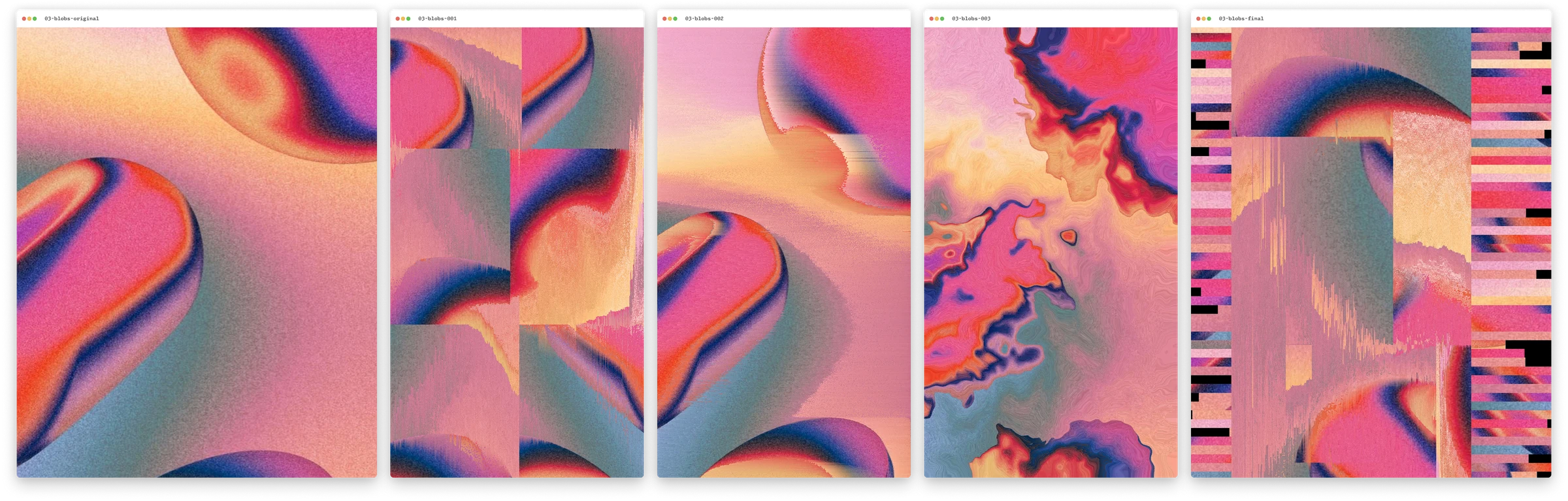
I'd experienced that as a flaw in me. It was a property of the material. I'm still sitting with how often that might be true.
The other thing that's crept up on me: the random search keeps handing me ideas I wouldn't have had. Not just single pieces — whole combinations, directions, things I now want to try on purpose. It's made me curious in a way I wasn't before. What happens if I feed it something that isn't a photo at all? What happens if I give it a pure white field, an image that's basically snow? I don't know yet. But I want to find out, and two weeks ago it wouldn't have occurred to me to ask.
So — did my AI make that?
I still don't have the clean answer. But I'm starting to think the honest one is that the question does what everyone's question does: it assumes there's a single hand behind the work. There were several. Mine was one of them. The rest of this experiment is really just me trying to work out which parts of it can only ever be mine.
More soon.