the wrong question about ai and art
A couple of weeks ago, a little script I'd been building handed me an image I never would have made.
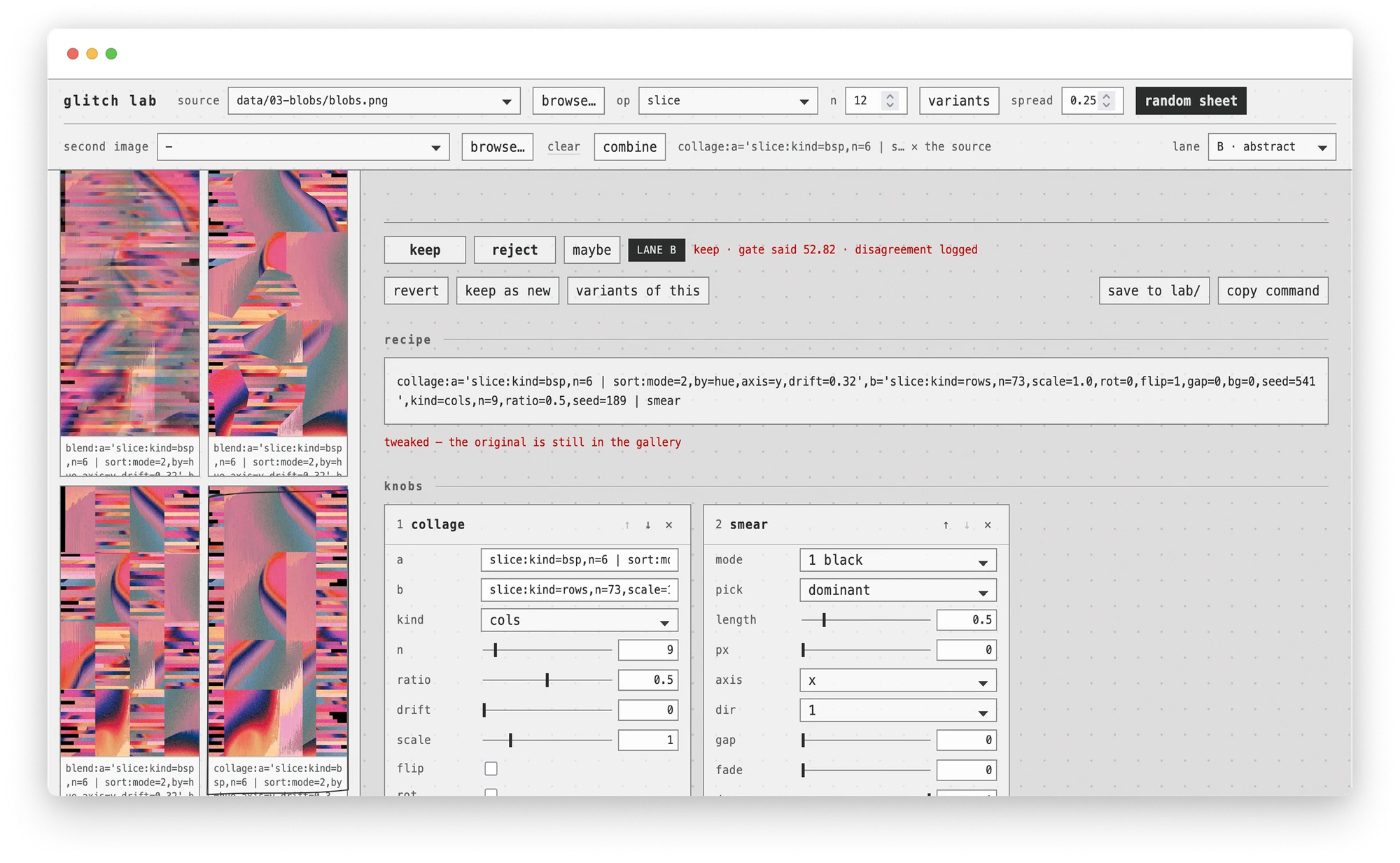
Here's what it did. It took one of my sourced photographs, ran it through a few hundred variations of my own glitch tools, scored every result against a set of rules I'd written down about what makes a piece good, and floated the best ones to the top. And sitting up near the top was a combination I'd never have reached for on my own — a pixel sort cut through a mask of thin diagonal lines, pushed harder than I'd normally dare. It was good. It looked like something I'd make. And I sat there for a second with a strange little feeling I couldn't quite name.
That feeling is the reason I'm doing this.
Because the question everyone jumps to — can AI just make the art for you? — is the wrong one. Not because it's rude to the machine. Because it's lazy. It smushes four completely different things into one word and then answers none of them.
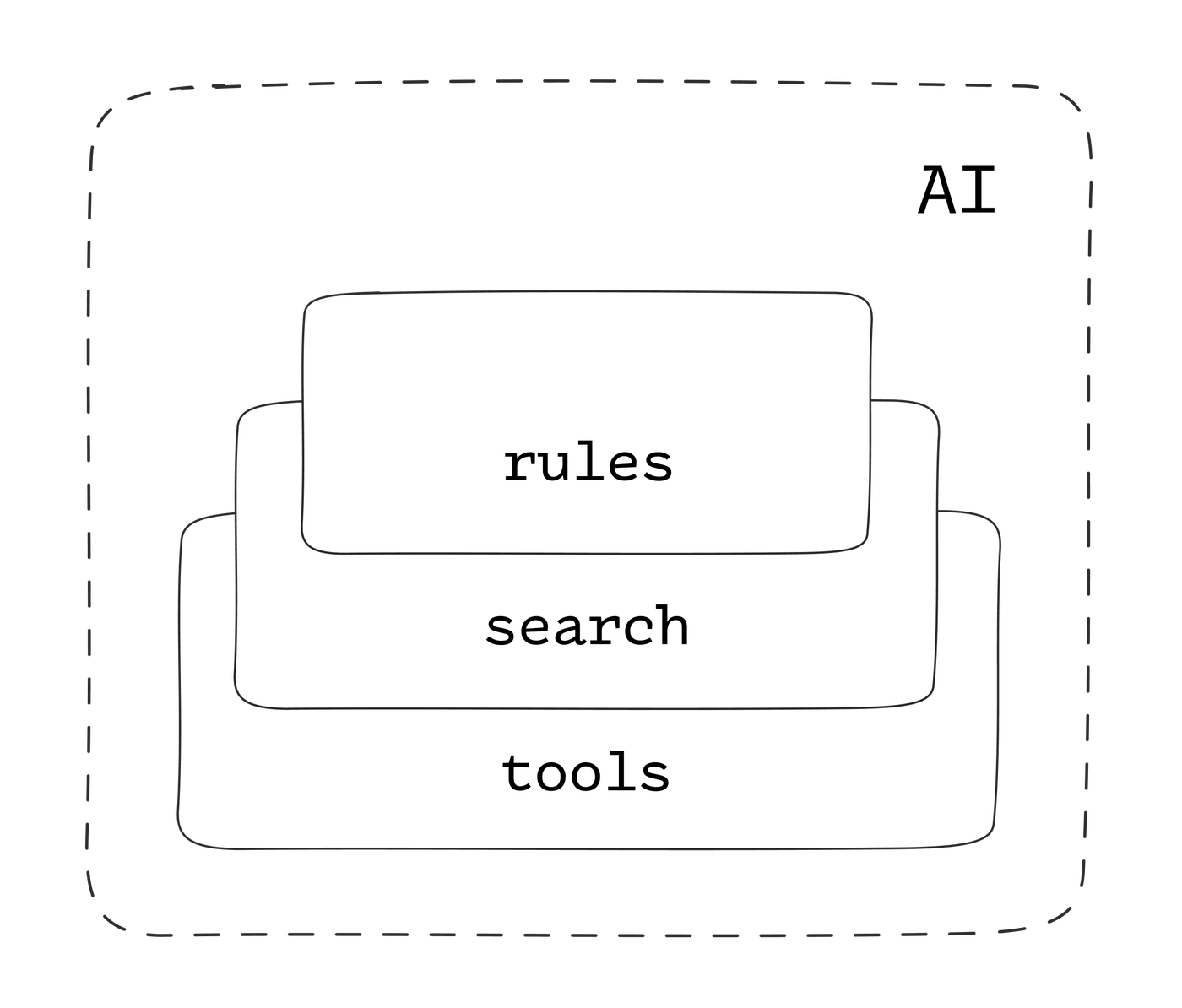
Let me pull them apart, because it took me a while to see it too. When I say “the AI made this,” I'm actually talking about four layers, and only one of them is AI:
- The tools — the lab where I move sliders and see a result in 200 milliseconds instead of waiting on a render. That's just good software. We had that in 2005.
- The search — the part that mutates a recipe, keeps what scores well, and tries again. That's a genetic algorithm. It's from the 1970s.
- The rules — the little scoring gate that decides which results are worth showing me. That's arithmetic. Rules I wrote, counted up.
- The actual AI — the thing that built all of the above, helped me put my taste into words, suggested new tools when I described a feeling, and argues with me about my own work.
Here's the part that surprised me: most of the reason I can explore more right now almost certainly comes from the first two layers, and neither of them is AI. A person with sliders and a fast preview will always wander further than a person editing a sketch and waiting on a render. That was true twenty years ago.
But — and this is the twist — those two layers only exist because of the fourth. There was no lab a couple of weeks ago. I didn't build it; I described what I wanted and it got built. So the AI's biggest contribution to my art so far isn't the exploring. It's that the whole apparatus exists at all. Which is easy to forget, because once a tool exists it just feels like it was always there.
So the real question I care about is smaller and more honest: where does the machine actually help me make art, where are my eyes non-negotiable, and what can I hand off entirely? There's a difference between running a machine and directing one, and I want to find the line — because I suspect that line is where “the artist” actually lives, and I've never had to say exactly where it is before.
what i'm not claiming
A few things I want to be upfront about, because I'd rather you knew them going in than caught them later.
This is one artist, one toolchain, four weeks. It is not a study. Nothing here generalizes in the scientific sense — and the honest, slightly funny thing about an experiment like this is that the most interesting part is admitting up front what won't transfer to you. I'm keeping numbers, but they're there to keep me honest, not to prove anything to you.
And the conflict of interest is baked right in: the AI designed the scoring, built the tools, and wrote the function that decides which of my images are “good.” I'm going to be leaning on a judge that the defendant built. I could pretend that's fine. It isn't, quite — so I'm naming it here, on the way in, because it changes how you should read everything that follows.
A couple of surprises have already turned up in these first two weeks, and they're not the ones I expected. I'll get to those. But I wanted to start here, with the strange little feeling of an image I didn't quite make and didn't quite not make — because that feeling turns out to be the whole experiment. And a few days later, someone said the exact question that's hiding inside it out loud.
More on that next.